Mt. Fuji's Mountaintop Research Facility
At Mt. Fuji's 3,776-meter summit, scientists study clouds, lightning, and climate. Vanguard Researchers features a mind-controlled prosthetic arm.
Transcript
Mount Fuji is Japan's highest peak.
But did you know that it's also home to a "scientific laboratory," a rarity even on a global scale?
This is heavy!
This group of scientists are lugging heavy-looking equipment to a research facility located at the summit.
Taking advantage of Mount Fuji's unique location, over 30 research projects are underway here,
including observations of substances that affect climate change!
Clouds are being carried in now by a strong westerly wind.
Research on clouds has been particularly fruitful.
This is because various types of clouds form over Mount Fuji.
Recently, "a certain substance" was discovered for the first time in these clouds, surprising researchers around the world!
But that's not all!
Mysterious lightning has also been spotted.
The view from the summit is so clear that you can even see lightning hundreds of kilometers away.
Today, we'll look at the little-known research facility atop Mount Fuji!
Mount Fuji is Japan's most famous natural monument.
It's a thing of real beauty.
But when you climb to the top, you see a different, harsher side.
The thin air and the strong wind are unwelcoming.
But for scientists, the top of Mount Fuji is an excellent place to do research.
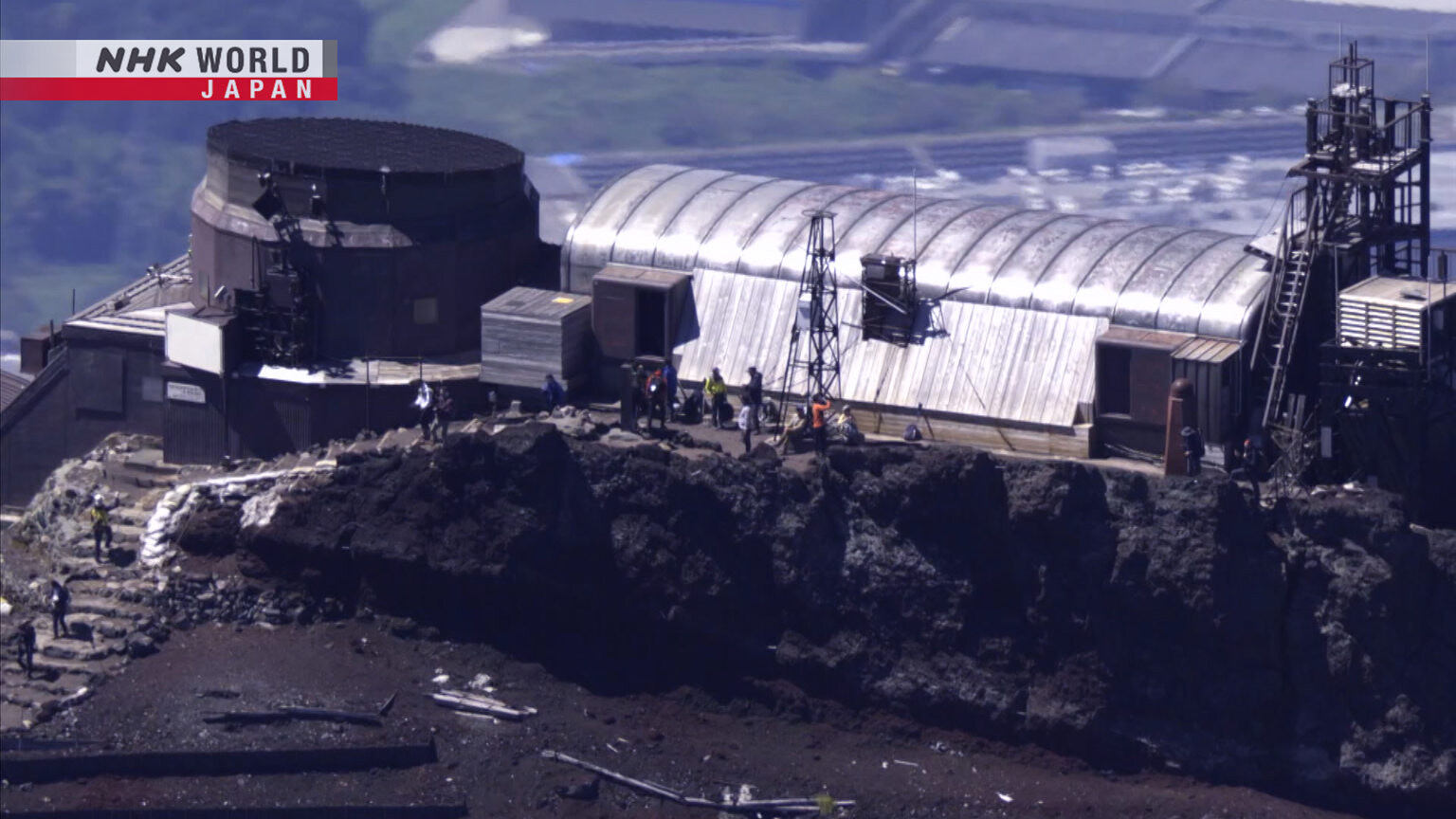
This is the research facility on Mount Fuji.
It sits on the summit's highest point.
It was originally a weather station established as a meteorological observation post,
in response to a typhoon that caused extensive damage in Japan.
Since 2007, scientists have been renting it for just two months every summer to use as a research base.
Let's take a look inside the research facility.
First, a large door with multiple locks catches the eye!
This door is actually constructed like the doors used in submarines.
Since winds on the summit of Mount Fuji can sometimes exceed 90 meters per second, wind protection is essential.
Stepping inside, we find a wide array of research equipment!
Power received from a utility company allows it to maintain a research environment similar to that at sea level,
despite the summit's high altitude.
And since altitude sickness is always a concern, there is even a room equipped for those feeling unwell.
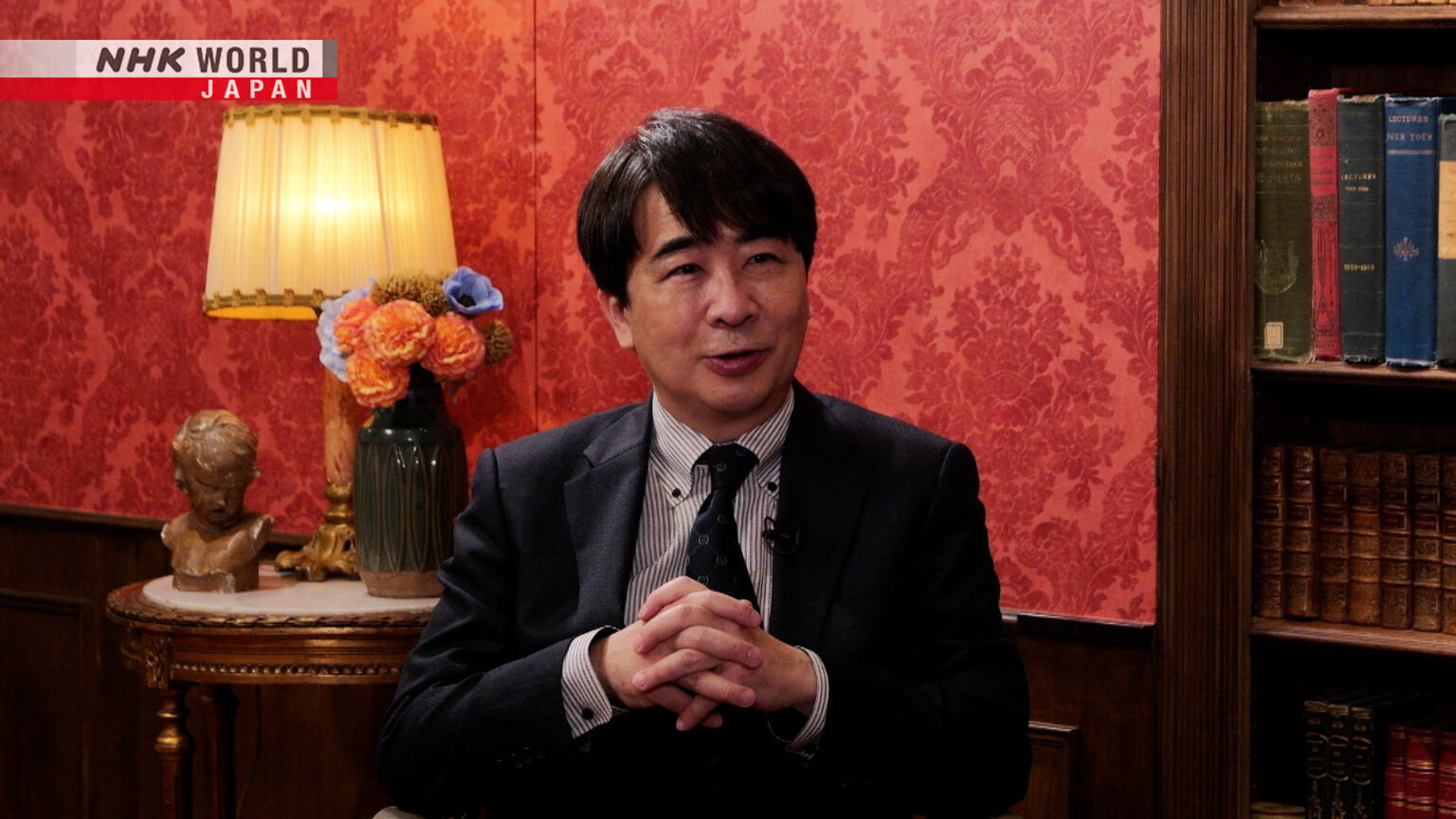
Today, it is my pleasure to welcome Dr. Kamogawa Masashi,
who is a Specially Appointed Professor at the University of Shizuoka,
and he is also Vice-chief Director of the NPO Mount Fuji Research Station.
Dr. Kamogawa, welcome.
Thank you.
I knew there was a building at the summit of Mount Fuji,
but I didn't know what kind of research was being conducted there.
There's a variety of research,
ranging from measuring pollution and greenhouse gases,
to studying lightning, communications and even astronomy.
Seems like it supports various research fields.
Is there any particular advantage to placing an observatory on the rugged summit of Mount Fuji?
"Mountain-based observation" is conducted in various places,
such as in Europe, China, or Mauna Loa in Hawaii.
Mount Fuji's pointed shape and isolated peak are advantageous.
The shape of some mountains can affect the air mass being observed.
Mauna Loa is certainly flatter, isn't it?
It's rounder.
Mt. Fuji's pointed shape makes it an ideal observation tower.
As Japanese researchers, we're lucky to have a mountain like this.
I see.
Could you tell us about some specific research results?
The biggest topic in our group now
concerns the finding of a certain substance in the clouds.
The summit of Mount Fuji is an ideal observation spot, where clouds from various locations converge.
Here, cloud researcher Dr. Okochi Hiroshi achieved a groundbreaking discovery.
That was...
We were the first in the world to find microplastics inside clouds.
Plastic waste flows into the ocean and pollutes the environment.
Pieces smaller than 5 millimeters are classified as "microplastics."
When ingested by fish and other organisms, they can have adverse effects on both the fish and the humans who consume them.
The discovery that microplastics are even present in clouds sent shockwaves around the world when it was published in a research paper.
Ten types of microplastics have been identified so far.
Okochi aims to identify as many types as possible and continue his efforts to pinpoint their sources.
So, how exactly does he collect these clouds?
We followed along with the survey conducted every summer.
First, they set up a device to collect clouds.
Clouds are essentially aggregates of "cloud droplets,"
water droplets formed when air cools and the water vapor within it condenses.
It's thought that microplastics are carried aloft by the wind and become trapped within these droplets.
The wind is strong right now.
Tiny cloud droplets about 10-20 microns in size are carried by this wind and collide with this device.
The droplets strike the device, flow through a tube, and accumulate.
By analyzing the composition of this liquid, one can identify the substances contained within the clouds.
Back at the university, the liquid samples collected over a month were analyzed.
A special light is shone on the liquid.
Over here is a particle that appears to be plastic.
A substance called "vinyl acetate ethylene" was discovered.
It is widely used in products such as artificial turf and adhesives.
As familiar substances are being discovered one after another within the clouds, Okochi is concerned about the impact on the climate.
It has been suggested that microplastics might act as nuclei for cloud formation,
and if they do form clouds, that would likely play a role in climate change.
Clouds are composed of numerous cloud particles.
For these to form, they require microscopic particles that act as "nuclei," to which water vapor can attach and gather.
These tiny particles are typically substances that readily bind with water,
such as salt particles carried up from seawater.
Some microplastics possess similar properties and can therefore act as cloud nuclei.
Okochi points out that if these clouds formed from microplastic nuclei continue to increase,
they could have unpredictable effects on the climate.
Clouds scatter sunlight, and it's been suggested that they may actually help cool the Earth.
On the other hand, since microplastics are essentially lumps of carbon,
they release greenhouse gases like methane and CO2 when they degrade.
In that case, they would work to warm the Earth.
I want to gather data and understand in detail exactly what is happening.
I was surprised to hear that microplastics act as nuclei.
How small are they?
About tens of micrometers in size.
And water droplets attach themselves to them.
It's possible that these microplastics are carried in from quite far away, isn't it?
Yes, air from distant places reaches Mount Fuji.
The region above about 2,000 m is called the "free troposphere."
Since it's unaffected by the ground, air masses can enter it from far away.
It's highly likely that the microplastics entered the atmosphere from sea spray.
They probably came from hundreds or even thousands of kilometers away.
I see.
When it comes to cloud research, one could use airplanes or drones.
Is there a particular advantage to taking measurements at the summit?
Mount Fuji's high altitude combined with having electricity at the summit,
means we can use very sophisticated instruments to take precise measurements.
And since the location is fixed, it's easier to track changes over time.
If you want to observe long-term fluctuations, the summit is the better choice.
Variations could affect the research data,
so scientists want to minimize the number of variables.
A fixed observation point helps.
What kind of research are you personally conducting?
I'm studying lightning.
Lightning!
Is Mount Fuji particularly good for that?
Yes, for 2 reasons.
First, lightning occurs in cumulonimbus clouds, or thunderclouds.
These very large clouds range from a few kilometers to around 10 km in height.
Since Mount Fuji is such a high mountain, it offers a clear view of the thundercloud structure.
You have an obstructed view far into the distance.
The second reason is that in summer, the base of a thundercloud is about 4 km high.
With observation equipment at the summit of Mount Fuji,
you're right inside the thundercloud, so you can make close-range observations.
It's at just the right height to observe the clouds intact.
You must be able to take impressive photos.
Yes, it's great for photography and especially video.
We can capture a wide variety of lightning discharges.
Here is footage of lightning captured by Kamogawa's team.
Numerous bolts of lightning are visible within the clouds.
On a clear day, lightning can be observed hundreds of kilometers away.
However, what Kamogawa is really after is "phantom lightning," a phenomenon rarely seen, even on Mount Fuji.
It shoots straight out of the thundercloud, and goes up all the way into space.
We call it "reverse lightning"...
In fact, Kamogawa has visited the summit over 100 times to try to capture this phenomenon, but only succeeded once!
Here is that phenomenon, which he captured 10 years ago!
Look at the far left of the screen.
Can you see the lightning stretching upward like branches?
This is a phenomenon called a "gigantic jet."
This occurred over Iwate Prefecture.
It's incredibly massive, stretching over 60 km from an altitude of about 20 km up to 80 km.
The lightning shooting out of the clouds doesn't head toward the ground, it extends straight up into space.
The mechanism behind this phenomenon, such as when and under what conditions it occurs, is not yet fully understood.
Since this is a good vantage point, the goal is to take high-quality photos and videos.
Late July is considered a prime time for gigantic jets to occur.
In temperatures of 6 degrees Celsius, he sets up a camera to capture a gigantic jet, which could appear anywhere at any time.
Lightning within a 300-kilometer radius can be observed from Mount Fuji's summit.
Kamogawa is aiming to capture his next gigantic jet.
With nothing blocking the view in any direction,
Mount Fuji really does function like an observation tower.
Did you observe one in summer 2025?
Unfortunately, I couldn't.
It's very difficult because lightning activity has to occur within a few hundred km of Mount Fuji.
And the summit can't be shrouded in fog.
Both conditions have to align, and that just didn't happen in 2025.
So it's quite a rare sight to capture.
What makes gigantic jets so fascinating?
A gigantic jet is a type of luminous phenomenon
known as "Transient Luminous Events," which occur between space and the clouds.
Other phenomena like "sprites" and "elves" have also been discovered,
but the gigantic jet is a rare phenomenon.
There's a romantic quality about it,
so it's probably the most popular among researchers.
What else can we learn from clarifying how these gigantic jets work?
When it comes to weather and climate, we don't really consider electrical phenomena.
However, the existence of gigantic jets shows
The Earth has a global atmospheric electrical circuit, and lightning plays a role in that.
Once we start taking into account the Earth's atmospheric electrical circuit,
climate change research will likely change,
and we might understand why extreme weather events are on the rise.
That's why gigantic jets are a very important subject of research.
It sounds like we can look forward to future developments.
What lies in store for the future of the mountaintop observatory?
We operate this facility by raising our own funds, without government support.
In order to keep it running, we hope that more overseas researchers will conduct research here.
We do have groups visiting from places like the US, France and Taiwan,
and I hope many more researchers will utilize it.
I see what you mean. Thank you very much for your time today.
Thank you as well.
Mount Fuji is a geological giant.
Personally, my interest in it has been as a volcano and the actions that shaped the Earth.
But as we've seen today, it's the same geological formation which also acts as a world-class laboratory.
By providing the perfect environment to study lightning and cloud formation,
Fuji is helping us decode the future of our weather and the shifting patterns of our climate.
When people lose a hand due to various circumstances, they have the option of...
a "prosthetic hand."
There are various types, ranging from those designed to improve appearance,
to robotic arm-style prosthetics, worn for tasks requiring fine motor skills.
In particular, research has been advancing on myoelectric prosthetic hands, which move by reading signals from the arm muscles.
You can move them any way you please, almost like a real hand!
In this episode of Vanguard Researchers, we'll introduce the latest research on these prosthetic hands.
Hello.
Nice to meet you.
Oh! A handshake?
Nice to meet you!
Wow! That's strong.
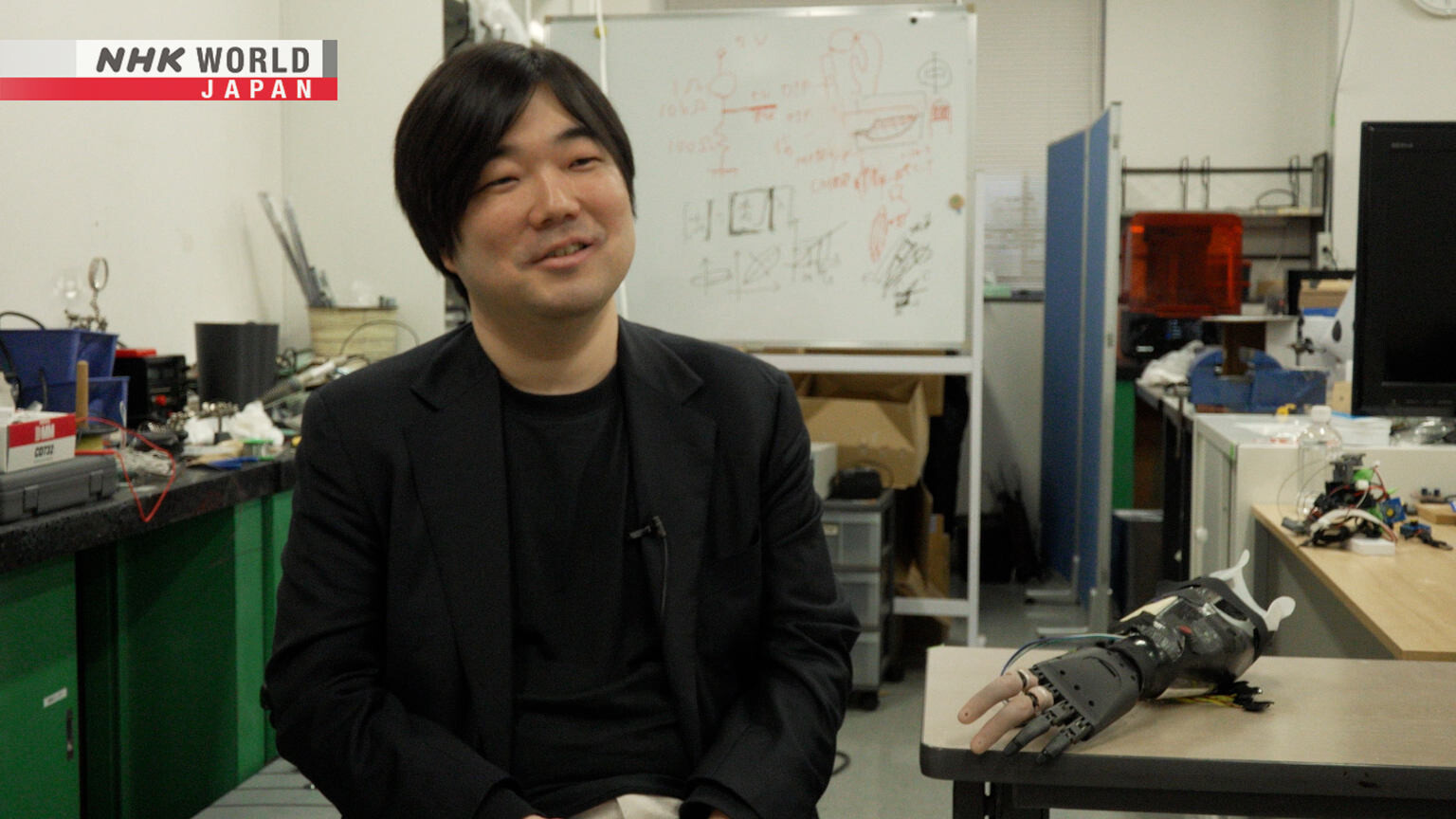
This is the developer, Dr. Yamanoi Yusuke.
Let's see this technology in action!
He grabs a plastic bottle and pours water,
all with remarkable ease.
Yamanoi developed this particular myoelectric prosthetic hand.
Its five fingers move independently, allowing it to replicate the various hand shapes we use in our daily lives.
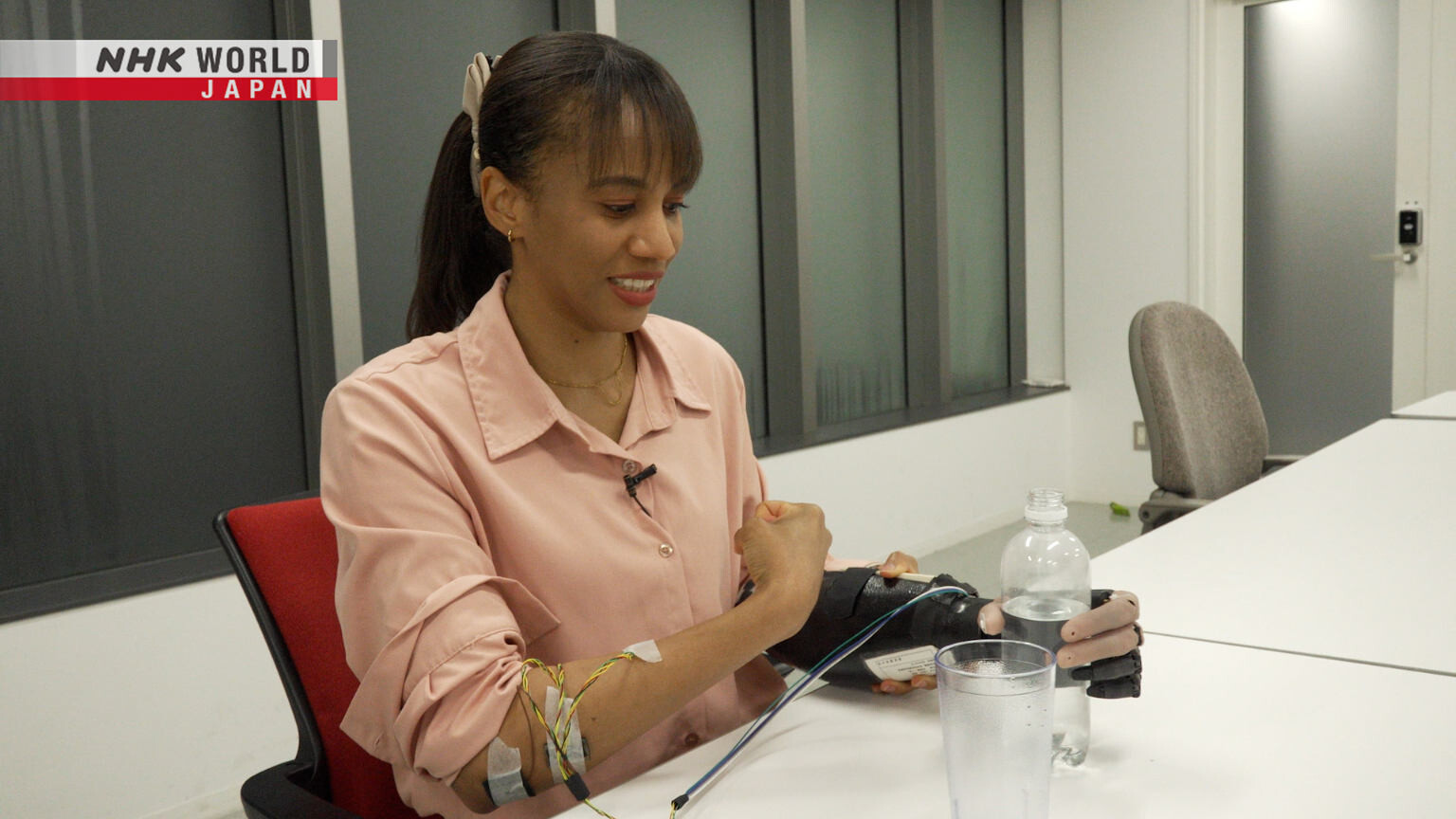
Now I'll try it out!
After the sensors are put on my arm...
Now I can move my hand.
So when I put it in a fist, it moves along with me.
Ooh!
And open.
How does it work?
When you move your hand, the brain first sends a command.
This is transmitted as a signal through the nerves to the arm muscles.
The electrical signal generated is called an "electromyogram," or EMG.
Sensors read these EMG signals, which is how the prosthetic hand is operated.
However, the signals are very weak and unstable, with patterns that vary from person to person.
They are not easy to detect.
The sensor positions were fixed in conventional myoelectric prosthetic hands,
so the prosthetic hand wouldn’t move unless one moved the muscles in those specific areas.
It took about 3 months of training here.
But with this prosthetic hand, the device itself learns the user's muscle activity,
so anyone can operate it immediately after putting it on.
What were myoelectric prosthetic hands like in the past?
We visited a center that manufactures prosthetics and orthotics.
This myoelectric prosthetic hand, made with a German technology, was first fitted to a patient in 2010.
It has two sensors located on the inside.
The sensors act like switches, enabling the user to grip and release objects.
However, it feels somewhat lacking for everyday use.
And this is the myoelectric prosthetic hand currently used by the largest number of users.
It's not as easy.
Even if I go like this, sometimes it doesn't move,
so, I have to kind of be deliberate about how I'm moving my arm.
So it seems like you need a lot of practice to be able to use this effectively.
At first glance, it appears to work on the same principle as Yamanoi's prosthetic hand, but it doesn't move as intended.
This is because the signals are weak and unstable.
Due to these difficulties in operation, the adoption rate of myoelectric prosthetic hands remains at less than 2 percent of all users.
Furthermore...
Because there's machinery inside, they're heavy and also very expensive,
and I think few people use them due to the cost.
The long-term goal is to develop a prosthetic hand that moves just like a natural hand.
Yet many challenges remain.
One is that the EMG signals vary from person to person.
Yamanoi has incorporated AI to address this issue.
The EMG pattern read by the sensors is displayed on this screen.
First, I perform a gripping motion for a few seconds.
This collects the EMG pattern when I clench my fist.
Similarly, when I perform an opening motion for a few seconds...
the shape of the lines changes, and this time, the EMG pattern when I open my hand is collected.
In this way, the characteristics of my EMG patterns are extracted.
The AI learns the EMG patterns in just a few seconds, and identifies which one the signals most closely resemble.
This is how commands are sent to the prosthetic hand.
It's like having a customized prosthetic hand!
It only took a few minutes, and despite being new to all this, I could operate it right away!
It was a lot easier than I thought to control my muscles, since I'm using the muscles that I'm already used to using.
I could see how this could be really useful for someone if they had this as their hand
and they could just flex as needed to control it.
The AI is embedded in this small microcontroller.
Despite its high performance, he managed to make it 100 grams lighter than commercially available myoelectric prosthetic hands.
Here is a video of a test conducted with an actual prosthetic hand user.
It can quickly perform even the most delicate movements.
With the maximum amount of government subsidy, it can be purchased for around 200,000 yen.
Things we take for granted are impossible for people who have lost a hand.
It makes me happy when they're deeply moved just by being able to do those things.
Technologically, I think we've reached a point where it's fairly easy to operate,
but since it's not yet widely adopted, raising awareness is incredibly important.
We hear more and more about how machines are beginning to merge with the human body,
and this research is a powerful example of that frontier.
So I hope you enjoyed hearing about the science we looked at today and that you will join us in the next installment,
in our search for new discoveries and ideas.